The Sensing Body: Carrying What Cannot Be Seen
Body kneels, carries, binds, leans, and rests. These familiar actions are close to the movements through which we work, care for others, and make a place for ourselves. I wanted to stay with gestures that could hold the pressure of an experience without explaining it. A body leaning against something presents a relationship to consider where the weight falls, what support is offered, and how long that position can continue. Through these actions, I approached the idea that runs through my work: how a history of violence enters ordinary life and continues.
Silent Bone grew out of research and work in Nepal, shaped by the country’s civil war and other upheavals. As a visual anthology, Silent Bone brought together four exhibitions: Nepali Sublime: Body in Translation; Of Memory, Place, and Residue; The Shape of Stillness; Reliquary for Remembrance, three on-site performances, and a performance at Mandala Theatre. While I recognized the limits of what I remembered, returning to Nepal brought residue of memory into contact with a place whose life had continued in my absence. That distance shaped my approach to memory, displacement, belonging, and my responsibility toward histories I had encountered in Nepal and elsewhere.
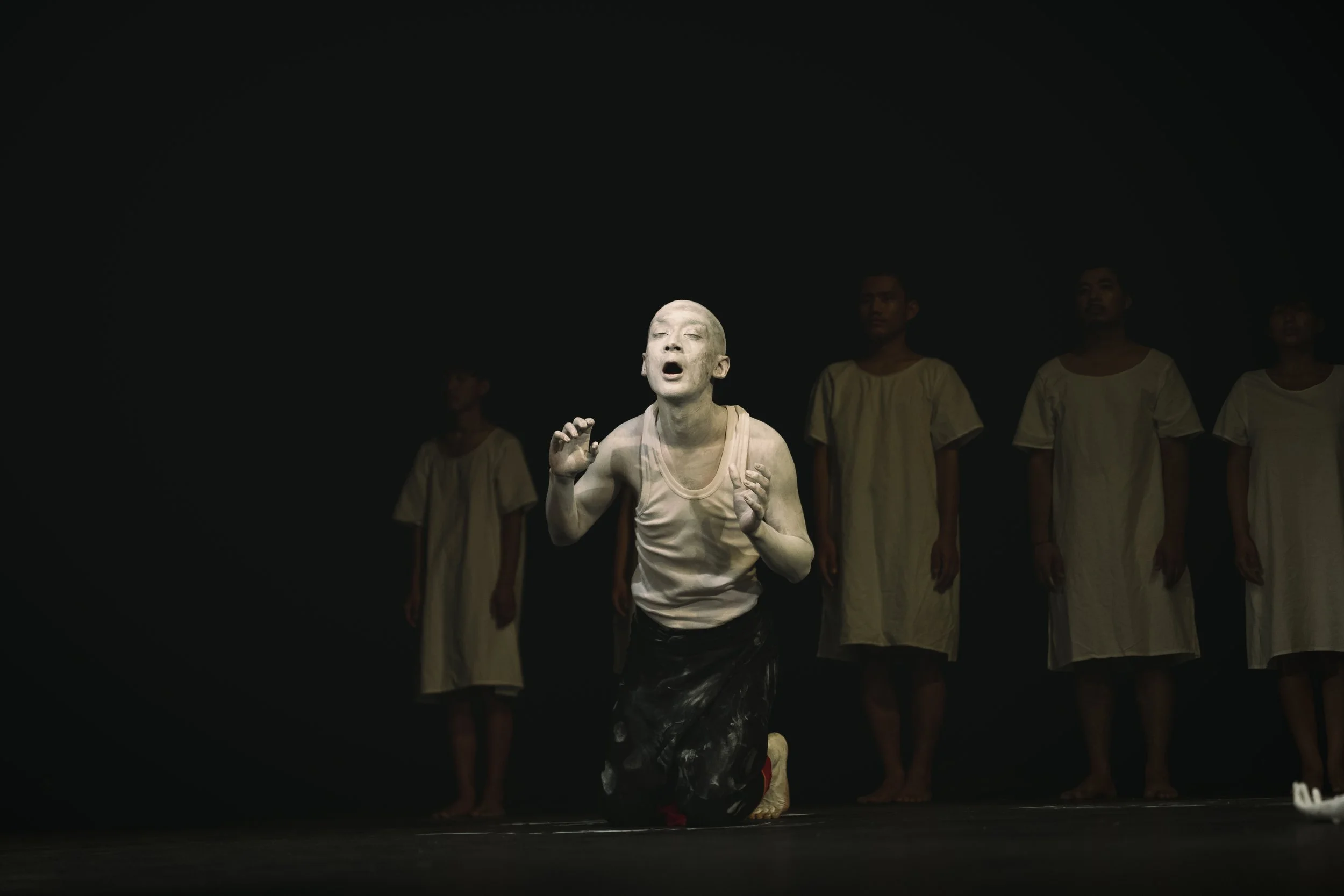
The theatre performance comprised five vignettes: Disappearance, The Empty Rooms, The Bone Speaks, The Street Learns to Breathe, and Before the Body Remembers. The titles bring different experiences into relation, allowing disappearance to be considered alongside dwelling, bodily memory, and public space. The performances leave room between these experiences. A space may be physically available while remaining difficult to inhabit. A place can be familiar and still hold an absence that changes our relationship to it. These are the ideas I wanted to approach through the body’s presence, its contact with materials, places, and durational actions.
This is where the question of violence becomes pertinent. In “Towards a Relational Phenomenology of Violence,” Michael Staudigl connects bodily vulnerability to the social meanings through which we understand ourselves, and to how violence affects a person’s capacity to act and their place within a shared world. When I describe the body as an archive, I think about knowledge learned through such relations: how we approach a threshold, accommodate a burden, or move through temporal and physical space with someone or somewhere else. Inherited memory includes the habits, stories, languages, silences, and expectations through which the past reaches people who did not experience it directly. A gesture can make this transmission perceptible while leaving its history unresolved.
Carrying gives this inquiry a physical form; it can be an act of care, necessity, labor, or obligation. In performance, the body responds to what it holds or doesn’t hold, and the object becomes inseparable from the effort of keeping it there. In my work, I am interested in that effort and the adjustments it requires. Grief has no single posture, and belonging has no reliable outward shape. Carrying allows performers to work with the demands these experiences place on a body. Repetition extends the encounter. Holding, waiting, and resting become ways of attending to what can be sustained and where a limit begins to appear; the materials participate in this process.
An object’s meaning develops through an encounter (1). A form associated with dwelling might suggest home, but its relation to a moving body requires an effort, scale, resistance, and duration. Sound and projection bring rhythms and textures into that relation. Across the project, objects, installations and drawings offer further ways of attending to a gesture.
A gesture encountered at important historical and cultural sites acquires meaning through its surroundings and the stories it carries. Working across various places allowed Silent Bone to remain dispersed, with each encounter contributing something another location could not provide. The on-site performances placed the work within locations that already had their own uses and histories.
Collaboration was equally important. Silent Bone came to fruition through student performers, volunteers, fabricators, sound, projection, and documentation. Their bodies and experiences shaped what became possible. In a project searching for inherent memory and ontology of belonging, the relations through which the work is made shape its meaning.
The passage between these locations also changes how I understand absence. A photograph can return me to a moment while making the distance from it more apparent. Video documents a durational gesture, although it cannot restore the conditions in which that gesture occurred.
As an artist, I remain careful about what a performance can claim or what and how a drawing or installation makes invisible visible. Watching an action does not give us access to another person’s grief. Stillness and restraint can invite attention, but they cannot guarantee understanding. Impermanence matters in my work because it brings attention to residue of how something is held, positioned, and arranged. It also draws attention to relations between people, relations between objects, and relations between temporal and physical space. Impermanence allows us to acknowledge the limits of the living body through sense and remembrance. Through this body, through this reliquary, I want to give that possibility time and form, while asking what kind of attention we owe to an absence that continues to shape lives by carrying what cannot be seen.
Binod Shrestha
(adapted and edited from 2026 SECAC Conference presentation)
(1. Graça Magalhães and Fátima Pombo: “From the Artistic Symbol to the Symptom of Art”)